
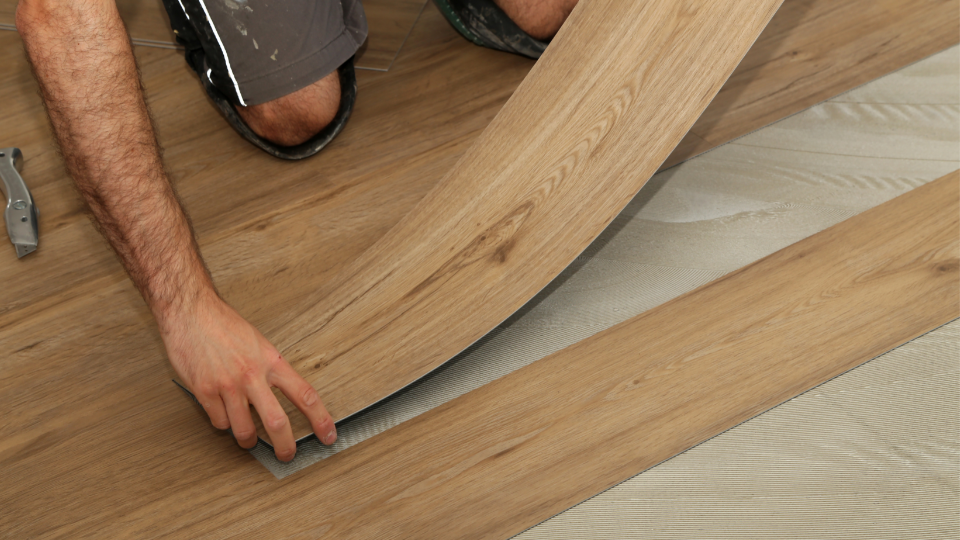
Vinyl flooring typically costs $2 to $11 per square foot installed in 2026, depending on the type. Sheet vinyl is the cheapest at $2 to $6, vinyl composition tile runs $3 to $6, and luxury vinyl plank or tile, the most popular choice, runs $4 to $11 installed, with materials alone at $2 to $7.
| Vinyl type | Material per square foot | Installed per square foot | Typical lifespan |
|---|---|---|---|
| Sheet vinyl | $1 to $3 | $2 to $6 | 10 to 20 years |
| Vinyl composition tile (VCT) | $1 to $3 | $3 to $6 | 15 to 25 years with waxing |
| Peel and stick vinyl tile | $1 to $3 | $2 to $5 | 5 to 10 years |
| Glue down luxury vinyl plank | $2 to $5 | $4 to $9 | 15 to 25 years |
| Rigid core click LVP (SPC or WPC) | $3 to $7 | $5 to $11 | 15 to 25 years |
What are the main types of vinyl flooring?
Sheet vinyl
Sheet vinyl comes in rolls 6 or 12 feet wide, so a small bathroom or laundry room can be covered with no seams at all. That makes it very water resistant and the lowest cost option. It needs a smooth subfloor because bumps show through, and it can tear if heavy appliances are dragged across it.
Vinyl composition tile
VCT is the 12 by 12 inch tile you see in schools and stores. It is tough and cheap, but it needs stripping, waxing and buffing to keep its shine, so most homeowners only use it in garages, workshops or utility rooms.
Luxury vinyl plank and tile
Luxury vinyl plank (LVP) and luxury vinyl tile (LVT) are thicker, printed with realistic wood or stone looks and topped with a clear wear layer. Rigid core versions use a stone polymer core (SPC) that resists dents, or a wood polymer core (WPC) that feels softer and warmer. Most click together as a floating floor, which keeps installation quick.
What makes one vinyl plank better than another?
Two planks that look the same in the store can perform very differently. These specs on the box tell you what you are paying for.
| Spec | Budget | Mid range | Premium |
|---|---|---|---|
| Wear layer | 6 to 8 mil | 12 mil | 20 to 28 mil |
| Total thickness | 2 to 4 mm | 5 to 6 mm | 7 to 8 mm |
| Core | Flexible, glue down | SPC rigid core | SPC or WPC with attached pad |
| Best for | Closets, low traffic rentals | Most homes | Pets, kids, kitchens |
- Wear layer matters most. For homes with pets or kids, 12 mil is the minimum most installers suggest and 20 mil is better.
- Waterproof is not leak proof. The planks shrug off water, but water that runs under the edges can still damage the subfloor, so seal perimeters in bathrooms.
- Attached pad saves a step. Planks with a built in underlayment cost a bit more but cut noise and installation time.
How much does vinyl flooring cost for common rooms?
Using a mid range rigid core plank at roughly $5 to $8 per square foot installed, here is what most homeowners pay before removal and trim. Small rooms often hit an installer’s minimum charge, commonly $300 to $600.
| Room | Approximate size | Typical installed cost |
|---|---|---|
| Half bath or laundry | 35 to 50 square feet | $300 to $600 |
| Full bathroom | 50 to 80 square feet | $400 to $900 |
| Bedroom | 150 to 200 square feet | $750 to $1,600 |
| Kitchen | 200 to 300 square feet | $1,000 to $2,400 |
| Main floor of a home | 800 to 1,200 square feet | $4,000 to $9,600 |
Add $0.50 to $5 per square foot if old flooring has to come up, and $1 to $3 per square foot if the floor needs leveling. Bathrooms usually run a little higher per square foot because the toilet has to be pulled and reset. Our guide to updating a bathroom on a budget shows how vinyl fits a low cost bathroom refresh.
What are the downsides of vinyl flooring?
Vinyl is not perfect, and knowing the limits helps you decide where to use it.
- It cannot be sanded or refinished; a deep gouge means replacing planks.
- Strong sun through large windows can fade cheaper prints, so use shades or UV film on south and west windows.
- Heavy furniture can dent thin planks; use wide felt pads.
- Floating floors need expansion gaps at walls, which baseboards or quarter round must cover.
- In higher priced homes, buyers may still prefer real hardwood; see our guide to the best wood for hardwood flooring if that is your market.
Can you install vinyl flooring yourself?
Click lock vinyl plank is one of the most do it yourself friendly floors, and a handy homeowner can lay a bedroom in a weekend with a utility knife, a tapping block, spacers and a pull bar. Where most DIY jobs go wrong is the prep, not the planks. A floor that dips or humps more than about 3/16 inch over 10 feet causes clicking joints to separate or squeak over time.
- Good DIY rooms: square bedrooms, offices and closets over a flat, clean subfloor.
- Better left to an installer: kitchens with cabinets and appliances, bathrooms with a toilet to pull, stairs and large open areas with many transitions.
- Glue down and sheet vinyl: trickier because adhesive open times and seam cuts leave little room for error.
Stair treads with vinyl stair nosing are a common example where paying for labor makes sense; installers often charge $40 to $100 per step because each tread is cut and glued by hand.
Is vinyl a good choice in hot, humid climates?
Yes. Rigid core vinyl is one of the safest floors for Gulf Coast humidity because it does not swell like solid wood or laminate. On concrete slabs, common in Dallas and Houston, installers lay a vapor barrier first; on raised homes in New Orleans, they check that the subfloor is flat and solid. Our article on what humidity does to your house explains why moisture control matters under any floor.
Vinyl also handles heat well inside a conditioned home, but planks in an unconditioned sunroom or garage can expand in summer heat. For those spaces, glue down vinyl or tile is the better fit. If you are planning several rooms at once, our walkthrough on booking flooring in Dallas covers scheduling and prep.
See your upfront price and book your vinyl flooring installation on House Fly through our flooring service. You book at the price you see, House Fly handles the rest, and payment is held until the job is done.
Frequently asked questions
How much does it cost to install 1,000 square feet of vinyl plank?
Most homeowners pay $4,000 to $11,000 to install 1,000 square feet of luxury vinyl plank, depending on the product and prep. Mid range rigid core plank usually lands around $5,000 to $8,000. Removing old flooring, leveling and new baseboards can add $1,000 to $4,000 to that total.
What wear layer do I need for vinyl plank?
For bedrooms and low traffic rooms, 8 to 12 mil is fine. For kitchens, living areas and any home with dogs or kids, 12 mil is the practical minimum and 20 mil holds up noticeably better. Commercial grade products go to 28 mil or more, which is overkill for most homes.
Is vinyl flooring waterproof?
Most luxury vinyl plank sold today is waterproof, meaning the planks themselves will not swell from spills or pet accidents. Water can still seep through seams and edges to the subfloor during a big leak, so bathrooms and laundry rooms should have sealed perimeters and quick cleanup when water pools.
Can vinyl plank go over tile?
Yes, rigid core vinyl plank can usually float over existing tile if the tile is firmly attached and flat. Deep or wide grout lines may need to be filled with a patching compound first so they do not telegraph through. Check door clearances and appliance heights, since the new floor adds height.
