
CRM is a fancy acronym for a simple job: remember your customers. Here is what that means for a small cleaning company, minus the enterprise software jargon.
Software vendors love the term CRM. It stands for customer relationship management, and the marketing around it comes wrapped in pipelines, funnels, touchpoints, and nurture sequences. An owner running a six person cleaning company can read a page of that language and reasonably conclude the whole category was built for somebody else. Strip the jargon away, though, and the idea underneath is old fashioned. Know who your customers are. Know what you did for them and what they paid. Know when they expect you next. Your grandmother’s hairdresser ran a CRM, and it was a card file next to the phone. This post translates the category for cleaning businesses, lays out the exact fields a customer record needs, and names the expensive features you can skip without losing a thing.
What CRM Really Means for a Small Cleaning Company
Forget the acronym for a minute and picture the three moments when customer information makes or breaks your day.
The callback
A client you have not heard from since winter calls about a spring clean. Can you pull up what you charged her, which products she asked you to avoid, and the note about the side gate in under a minute? If yes, you sound like an established operation. If the answer lives across a notebook, a message thread, and your memory, you sound like you are starting from scratch.
The handoff
You get sick, or you finally hire help. Can someone else run tomorrow’s route without calling you six times? A CRM is the difference between a business and a job that only you can do.
The money question
Who owes you right now? Which estimates are still sitting unanswered? A customer record that is not connected to estimates and payments forces you to run a second tracking system on the side, and that second system is usually your memory on a busy Friday.
The Six Fields a Cleaning Customer Record Needs
Here is the whole thing. Capture six fields per customer and you have a working cleaning business CRM, no matter what tool holds it.
| Field | Example | Why it earns its place |
|---|---|---|
| Name and service address | Dana R., 414 Oakview Ct, side entrance | The anchor everything else hangs on |
| Contact details | Cell number and email | How estimates and reminders reach her |
| Access notes | Gate code 4482, key under the planter | Prevents locked door visits that pay nothing |
| Home notes | Two dogs, no bleach, kitchen is the priority | Makes visit three feel as personal as visit thirty |
| Price and rhythm | $140 every two weeks, Thursday mornings | Ends renegotiation and awkward price memory tests |
| History | Visits, estimates sent, payments received | Settles disagreements and shows who your best clients are |
A spreadsheet can hold all six, and plenty of owners start exactly there. We wrote a separate guide on organizing your cleaning client list if yours currently lives in four places at once. The mentors at SCORE, who charge nothing, give small companies the same advice constantly: write the system down before you hire, because a system in your head cannot be delegated.
Enterprise CRM Features a Cleaning Business Can Skip
Big platforms charge big money because they build for companies with sales departments. When you evaluate software, treat every item below as a cost, not a bonus.
- Sales pipeline boards. You do not have a sales team moving deals through stages. You have people asking for prices.
- Prospect scoring. Algorithms ranking your contacts add nothing when you personally know every client.
- Automation builders. Multi step workflow designers take hours to configure and mostly get abandoned by week two.
- Custom reporting suites. You need revenue, upcoming visits, and unpaid balances. That is not a reporting suite, that is a screen.
- Role and permission trees. Franchise grade controls for a six person company are shelf space you rent forever.
The Small Business Administration’s guidance on managing your business keeps returning to one principle: match your systems to your actual operation. Complexity you do not use is not an asset. It is a recurring bill with a login screen.
Setting Up a Cleaning Business CRM Without a Big Project
The reason owners put this off is the setup, so pick a tool that meets your data where it already is. House Fly Pro gives you three doors in. Hand it a CSV or Excel file. Let it pull in the contacts already sitting on your phone. Or send your list, in whatever shape it is in, to the House Fly team by email and they will build your records for you while you work.

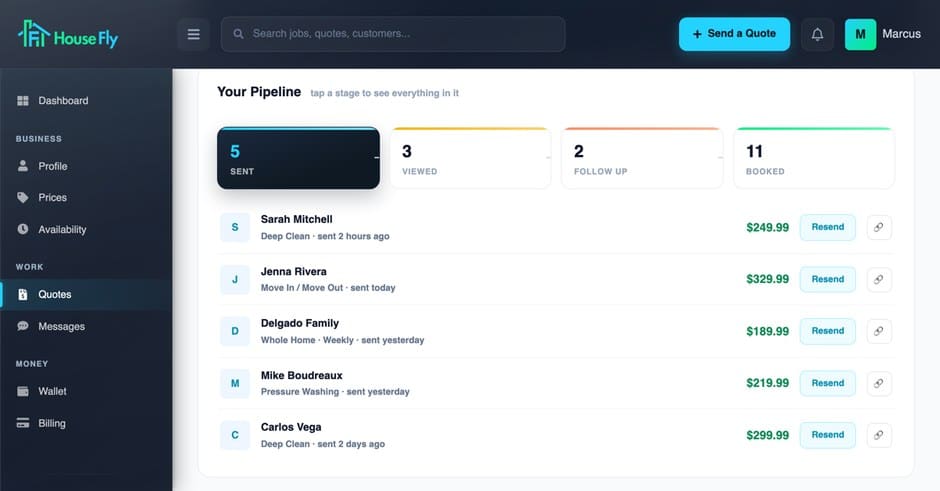
Once the list is in, the six fields live in one dashboard alongside the tools that use them. Estimates go out by text or email straight from the record. Payments land against the same record. Conversations stay attached to it too, which matters enough that we covered it separately in our post on messaging customers while keeping your number private. The price is $19.99 a month for you and $9.99 for each person you add, so the six person company from the top of this post runs $69.94. No contract holds you, and the first 14 days are a trial, so you can open an account and judge it with your real client list. Industry groups like ISSA have pushed cleaning companies toward this kind of professional record keeping for years. It used to require an office manager. Now it requires an afternoon. For the bigger picture of what software should and should not do for you, our complete 2026 software guide covers the whole landscape.
Six fields, one dashboard, $19.99 a month for one person. House Fly Pro keeps every client record next to its estimates, payments, schedule, and messages, and each teammate you add is $9.99 a month. The first 14 days are a trial. Start your House Fly Pro trial with the list you already have.
Frequently Asked Questions
Does a small cleaning company really need a CRM?
It needs what the acronym describes, not what enterprise vendors sell. Past a dozen or so clients, memory and paper start dropping details like access notes and unpaid balances. A simple system that keeps six fields per customer next to your estimates and payments does the whole job.
What should a cleaning business record about each customer?
Six things cover it: name and service address, contact details, access notes, home preferences, the agreed price and visit rhythm, and a history of visits, estimates, and payments. If your tool captures those, it is doing the job no matter what the label says.
Which CRM features are a waste of money for a cleaning company?
Sales pipeline boards, prospect scoring, workflow automation builders, custom reporting suites, and complex permission systems. Those exist for companies with sales departments and layers of managers, and they raise the price of software without helping a small cleaning operation.
What is the easiest way to start a CRM from an existing client list?
Start from wherever your data already lives. House Fly Pro accepts a CSV or Excel upload, can pull in the contacts saved on your phone, or you can email your list and the House Fly team will do the setup for you. Any of the three gets a working system running the same day.
