
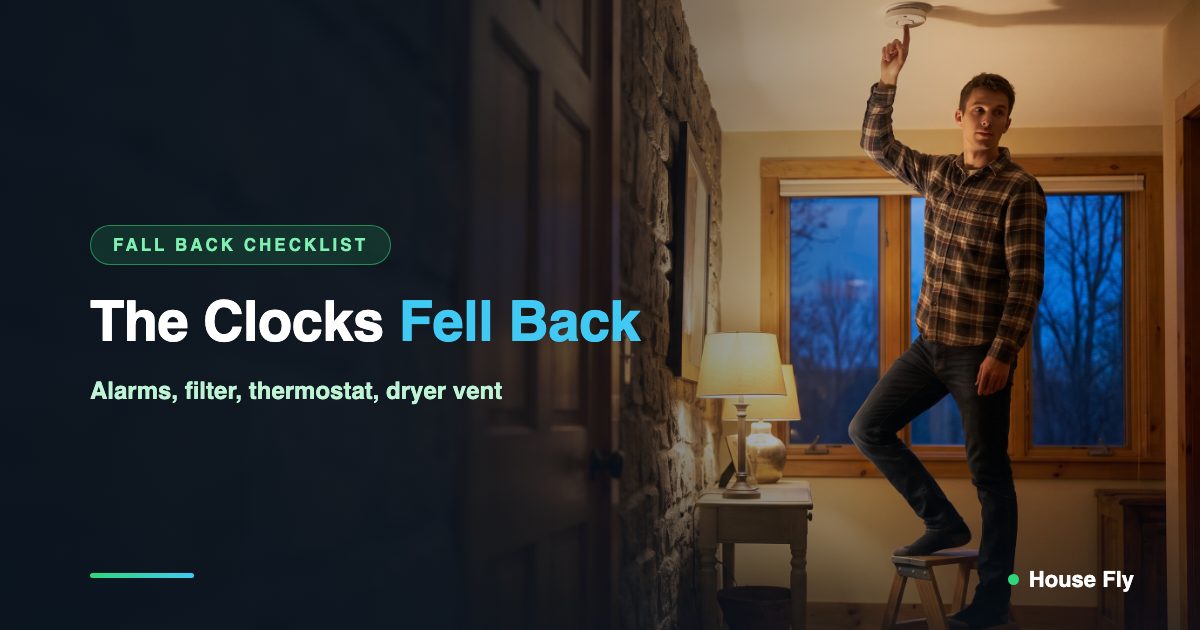
The clocks fell back yesterday. Use the hour on four jobs: smoke alarm batteries, the furnace filter, the thermostat schedule and the dryer vent. Two are DIY, two are worth booking.
The oven clock is still wrong, the car clock will be wrong until March, and the only clock that actually matters this week is the one inside your smoke alarm. Fire departments have used this weekend as a reminder for decades, and they are right, but the list is longer than batteries. The heat just came on for real, it is dark at 5:30 p.m., and the dryer has been running sweaters all weekend. Here is the fall back checklist for 2026: what each job is, which to do yourself this week, and which a handyman, an electrician or an HVAC tech does better and cheaper than you think.
The Fall Back Checklist at a Glance
Four core jobs and four small extras. Prices are typical 2026 ranges for a single visit and vary by home and city.
| Job | DIY time | Book it, typical 2026 cost |
| Smoke and carbon monoxide alarms | 20 minutes with a step stool | Handyman or electrician, $75 to $150 for several alarms |
| Furnace filter | 5 minutes | HVAC tune up with filter, $90 to $200 |
| Thermostat schedule | 15 minutes | Smart thermostat install, $100 to $250 labor |
| Dryer vent | Lint trap only | Dryer vent cleaning, $100 to $200 |
| Porch and motion lights | Bulbs and timers | Electrician for new fixtures, $150 to $350 |
Smoke and Carbon Monoxide Alarms
Start here, because this is the one job on the list that saves lives rather than money. Press the test button on every alarm in the house. If it chirps weakly or not at all, replace the battery today. The NFPA recommends smoke alarms inside every bedroom, outside each sleeping area and on every level, including the basement. Count yours against that list and you will probably come up short by one or two.
The 10 year rule
Look at the back of each alarm for a manufacture date. Smoke alarms are replaced after 10 years, carbon monoxide alarms after 5 to 10 depending on the model, no matter how new the battery is. The sensor wears out. If the date is faded or missing, the alarm is old enough to replace. Newer sealed alarms come with a 10 year battery, which ends the 3 a.m. chirp for a decade.
Carbon monoxide needs its own alarm
With the furnace, the water heater and maybe a fireplace all burning fuel again, the Consumer Product Safety Commission recommends a carbon monoxide alarm on every level and outside sleeping areas. If your alarms are hardwired and interconnected, or you have cathedral ceilings and no ladder, book a handyman or an electrician for the whole set in one visit, usually $75 to $150 for the labor on several alarms.
The Furnace Filter and the First Real Heat
If you did the ten minute check we described in our furnace tune up cost guide in October, you are ahead. If not, this is the week. Pull the filter, hold it up to a light, and if you cannot see light through it, it is done. A one inch filter is replaced every 1 to 3 months during heating season; a thick four or five inch media filter lasts 6 to 12 months. Write the date on the frame with a marker. ENERGY STAR notes that a dirty filter makes the system work harder and raises the bill, which is the most expensive way to save eight dollars.
When it is more than a filter
A new filter will not fix a boom at startup, a burning smell that lasts more than the first ten minutes, short cycling, or a room that never warms up. Those are tune up problems. An HVAC tune up on House Fly typically runs $90 to $200, includes the filter and a burner cleaning, and the tech checks the heat exchanger, which is the part that matters for carbon monoxide. The ENERGY STAR furnace page recommends an annual checkup for exactly that reason.
The Thermostat Schedule for Standard Time
Your thermostat does not know the clocks changed unless it is connected to the internet. Older programmable models are now running your morning warm up an hour late, which means a cold kitchen at 6 a.m. and a warm empty house at 9. A sensible standard time schedule for a house that empties during the day looks like this:
- Warm up to your comfortable temperature 30 minutes before the first alarm goes off
- Drop it 7 to 10 degrees when the house empties, if it empties
- Bring it back up 30 minutes before the first person comes home, which is now in the dark
- Drop it again at bedtime, since most people sleep better a few degrees cooler
Fifteen minutes with the manual, or a smart thermostat that learns the pattern and adjusts for the time change on its own. Installing one is a $100 to $250 labor job for an HVAC tech or an electrician, plus the device. If your system has no common wire, common in older homes, book it rather than guess.
The Dryer Vent Nobody Thinks About
The lint trap catches most of the lint. The rest travels down the vent, sticks to the walls of the duct, and dries into something that burns beautifully. Signs that your vent needs attention: clothes take two cycles, the top of the dryer is hot to the touch, the laundry room smells warm and musty, or you can see lint around the outside flap. Clean the trap every load and the vent once a year, and fall is the time because the dryer works hardest from now to March. A brush kit handles a short straight run. A long run, a roof exit, or a flexible foil duct behind the dryer is a handyman job at $100 to $200, and they can swap that foil duct for rigid metal while they are back there.
Four Smaller Jobs for the Same Afternoon
- Reverse the ceiling fans to clockwise on low so warm air gets pushed back down from the ceiling
- Disconnect garden hoses and shut off outdoor faucets before the first hard freeze
- Press the test and reset buttons on every GFCI outlet in the kitchen, bathrooms, garage and outside
- Put the porch light on a dusk to dawn timer or a photocell, since trick or treaters are gone but delivery drivers and guests are not
Keep a flashlight with fresh batteries where you can find it in the dark, and read through the ready.gov winter weather page once while the power is on. If the front walk is lit by one 40 watt bulb, a motion light at the garage and a fixture by the door is a $150 to $350 electrician visit.
Who to Book for Each and How It Works
Alarms, dryer vent, fans and timers go to a handyman. The furnace and the thermostat go to an HVAC tech. New fixtures, new outlets and anything inside a panel go to an electrician. On House Fly you search the service, see the upfront price before you book, and book in a few taps; paying securely is what confirms it, so there is no quote visit and no callback to wait on. Handyman, HVAC and electric are three of 17 home services on the platform, anywhere in the US. Many people book the handyman for the alarms and the vent this week and the HVAC tune up the week after, so the whole list is done before Thanksgiving guests plug in a second space heater.
You got an hour back. Spend it on the alarms and book the rest. Search the service, see your upfront price, and book in a few taps. Book it on House Fly and have the furnace checked before the first real cold snap.
Frequently Asked Questions
How often should I change smoke alarm batteries?
Replace standard batteries at least once a year, and the time change weekend is the easiest reminder. Test every alarm monthly with the button, and replace the battery right away if one chirps. Alarms with sealed 10 year batteries need no battery changes, but the whole unit is replaced at the date printed on the back.
When should smoke and carbon monoxide alarms be replaced entirely?
Smoke alarms are replaced 10 years after the manufacture date on the back, and carbon monoxide alarms after 5 to 10 years depending on the model, even if they still beep when tested, because the sensors lose sensitivity. If you cannot find a date, the alarm is old enough to replace. A handyman can swap every alarm in one visit.
How often should a furnace filter be changed in winter?
A standard one inch filter is changed every 1 to 3 months during heating season, more often with pets or allergies. Thicker four or five inch media filters last 6 to 12 months. Hold the filter up to a light; if you cannot see through it, replace it. A clogged filter raises your heating bill and strains the blower motor.
What does dryer vent cleaning cost in 2026?
Dryer vent cleaning costs $100 to $200 in 2026, depending on the length of the run and whether it exits through the roof. Book it yearly in fall, because lint is a leading cause of dryer fires and a clogged vent makes every load take longer. Swapping a foil duct for rigid metal can be done on the same visit.
